
August 27, 2026, by Michael Armstrong
Special to The Seward Folly
Seward could see 500 more workers and a $250 million boost to the economy if an expansion of the JAG Seward Shipyard proceeds as envisioned.
At Monday’s Seward City Council meeting, Tim Jagielski of JAG told the council of its expansion since moving to Seward in 2018 and what could be on the horizon if the shipyard becomes a maintenance facility for the U.S. Coast Guard fast response cutter and Arctic icebreaker to be based in Seward. Jagielski said JAG has been working on expansion design at its Sockeye Point facility well before the Coast Guard announced Seward would receive the new ships.
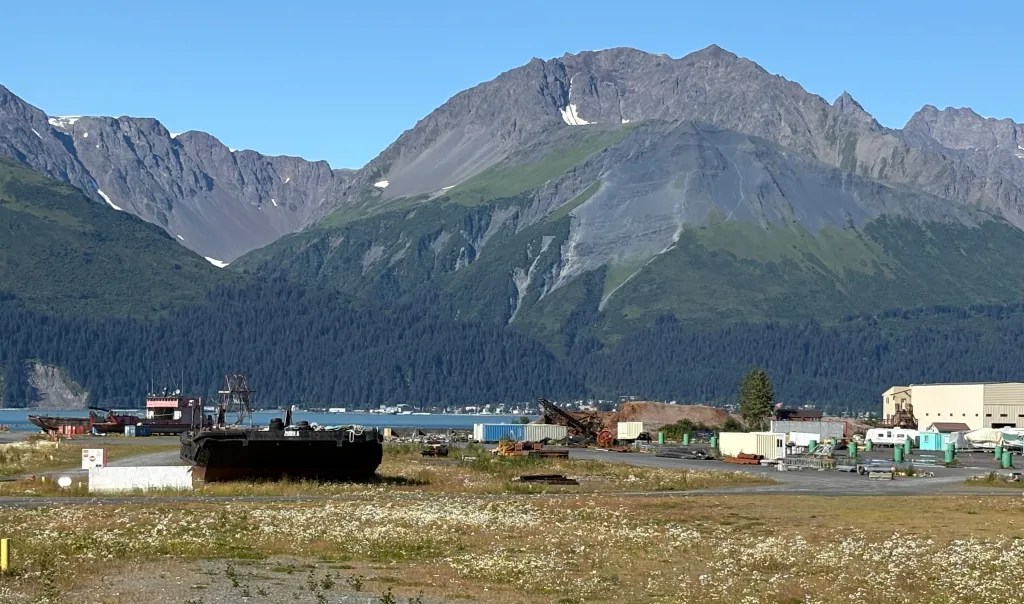

Sockeye Point (Seward Folly photo) and JAG Shipyard (JAG website photo)
JAG also owns a shipyard in Ketchikan. Since 2018, its Alaska properties have grown 800% and its Seward property has grown 733%. Employment in Seward jumped from five full-time equivalent workers to a high now of 225. Recently, JAG received a $1.5 million U.S. Department of Transportation Maritime Administration (MARAD) grant to improve its rail system. Another local company, Catalyst Marine Engineering LLC got a $600,00 MARAD grant. In 2025 JAG did a $90 million repowering project for the Oscar Dyson and this year won a $100 million repowering project for a second vessel.
With its growth has come a good problem: JAG is constrained by capacity, Jagielski said.
“We need something in order to keep this growth going. We need to to make some changes. I think you’re probably aware of this,” he told the council. “…We really think this is a great opportunity with this Coast Guard expansion in Alaska.”
Having cutters based in Seward can bring a boost to the economy, but what if Seward went further and also became the shipyard to maintain those cutters?
“So someone’s got to maintain them, and we’ve been making our pitch that we would like to maintain them here in Seward, and Wrangell and Ketchikan,” Jagielski said.
He said there can be a strategic value to maintaining Coast Guard cutters in Alaska. Looking at data for current icebreakers, between missions and maintenance, they could be away from home 300 days or more.
“The value of having a home port with the shipyard that can maintain them in the same facility is very high,” Jagielski said.
That’s not including the cost of moving a ship between its home port and a shipyard in the Lower 48.
“You’re talking half a million dollars each way, so it’s a big savings for the Coast Guard too if they can if they can get their maintenance done up here,” he said. “… We want to, we pitch the shared facility support, which would reduce their cost and give them a great solution for home porting as well as maintenance.”
Thinking even bigger, with an expansion, Seward could handle maintenance for larger Coast Guard vessels like the Offshore-Patrol and National Security Class cutters. Seward might even be able to do maintenance for U.S. Navy vessels like the Arleigh-Burke or DDG class ships. That would be a $150 million project.
“So there’s there’s a lot of opportunity for all these to move forward, and it really — it’s a game changer for Alaska, but it’s a game changer for the nation,” Jagielski said.
To expand, the city and JAG would need to find more land for not just industrial space but housing.
“We were able to identify, you know, over 200 acres of land that the owners have committed to making affordable, and we could offer that up to the Coast Guard for housing and development,” Jagielski said.
In questions from the council, Council Member Robert Barnwell asked about electricity needs.
“Sounds like you know you’re using 10 megawatts minimum,” Barnwell said. “… So do you guys have a plan for that?”
Jagielski said he thinks the power is there even if they have to buy more power from Chugach Electric. One disadvantage to Seward compared to Southeast Alaska shipyards is the high cost of electricity. Southeast generates electricity through hydropower.
Seward City Manager Kat Sorensen said the power needs of Seward’s shipyards has been part of its planning.
“As we look forward at our generation capabilities in Seward, that we’ve been very mindful of, of recognizing that if we see this expanded growth, being able to be cost-effective in comparison is really, really impactful for our community as a whole,” she said.
Jagielski closed his presentation by noting that between new Coast Guard families and maintenance workers, that could bring more money into town — the schools full and kids running around.
“It’s just exciting times,” he said. “You know, we couldn’t, couldn’t be in a better place and at a better time right now than where we’re at with what’s happening.”
Michael Armstrong is a retired journalist currently volunteering as the editor of the Homer Independent Press. Reach him at wordfolk@gmail.com.
The Seward Folly co-publisher Robert Barnwell is a current member of the Seward City Council, but he did not participate in the editing of this story.
Leave a Reply